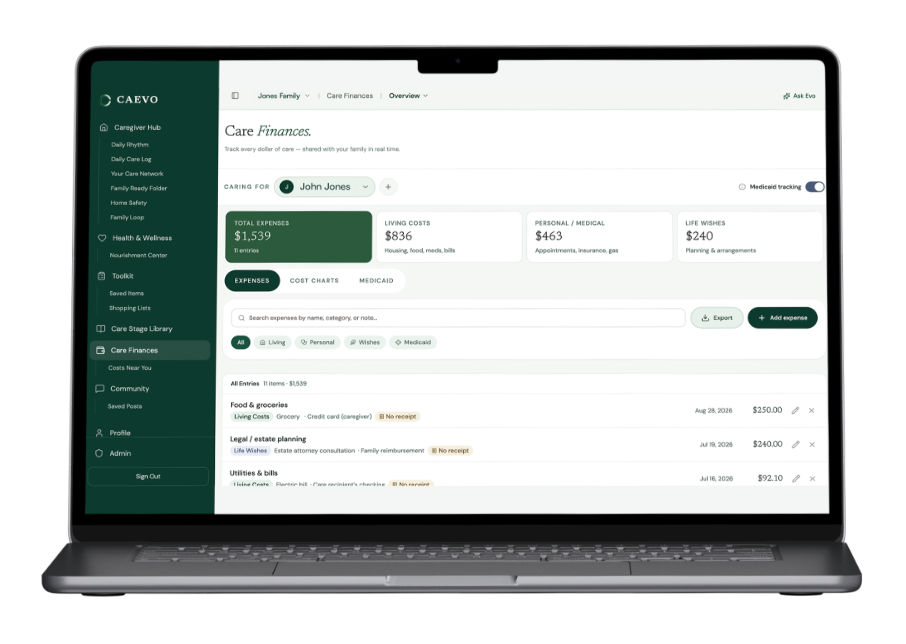
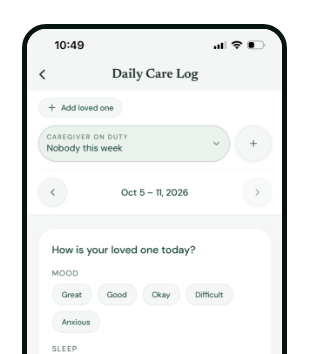
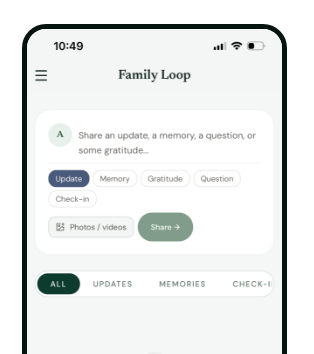
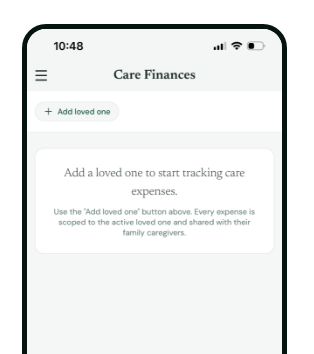
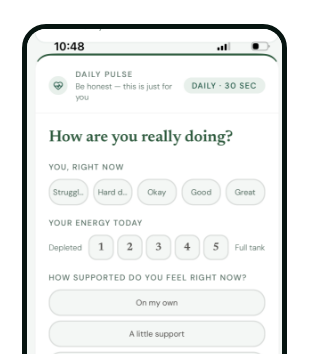
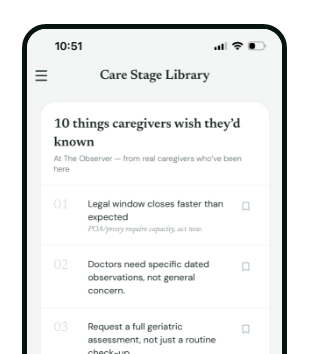
• Key Document Planning and Sharing • Easy Family Communication • Recommended Next Steps • Financial Resources • Aging Well Index • Document Vault • Benefits Finder • Care Stage Tracker • Family Loop • Consent-first Sharing • Ask EVO • 256-bit Encryption • No ads, ever
Nobody handed you a map.
This one redraws itself.
You’re probably 40 to 55, working full time, and this landed on you without much warning. Maybe there was a fall, or a bill that didn’t make sense, or a phone call that didn’t sound right. Since then, you’ve been researching at night and getting nowhere, because everything you find is written for somebody else’s situation.
The Caregiver Hub is built for exactly where you are. Not the beginning of caregiving, not the end of it, wherever your family actually is right now.
Explore the Caregiver Hub
Start wherever your week is hardest. Each page goes deeper on one part of caregiving.
Everyday Care
Daily care log, routines, medications, and appointments in one place.
Why Family Caregivers Need
a Dedicated Support App
Coordination is the job nobody counts: the same update sent five times, the document that’s somewhere, the sibling who feels shut out, and the one who’s checked out entirely. Say it once. Everyone knows. No more group text.
And most families are owed more than they claim. A spouse can keep up to $162,660 before spending down for Medicaid. Veterans and surviving spouses can get up to $2,874 a month in Aid & Attendance. Almost nobody applies, because almost nobody’s told.
You’ll see the real cost before you’re in it, and finally, this doesn’t all have to be yours to carry.
Understanding Your Loved
One's Care Stage
The five-year Medicaid look-back catches families who find out about it four years too late. Knowing your stage now, not after the second hospitalization, is what makes early planning possible instead of theoretical. The Care Stage Guide re-orients the whole product around wherever you actually are, so you’re not being handed a starting point built for someone three years behind or three years ahead of you.
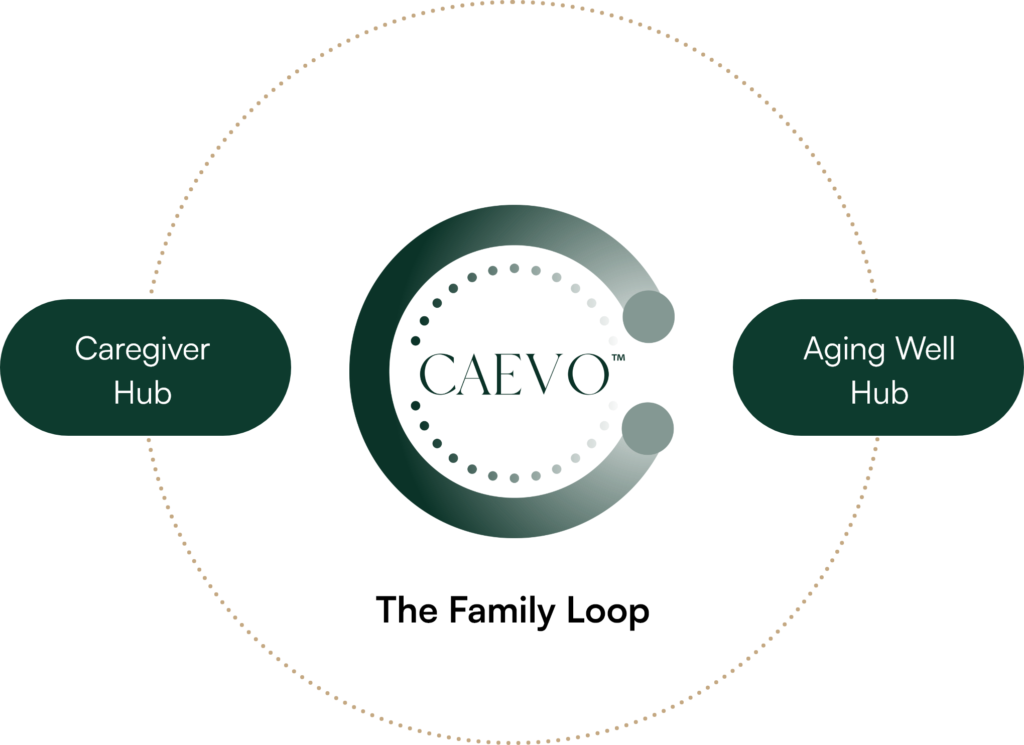
If your loved one has connected through the Family Loop, both hubs stay in sync on exactly what’s been shared, nothing more.
Uncover Benefits and
Plan With Confidence
Fifty states of programs, waivers, transportation, meals, respite, legal aid, assembled in one place instead of you finding one by accident three years too late. That’s not something you’re expected to piece together alone at eleven at night. It took us months to build, and we do this for a living.
Setting Up Your Caregiver Hub, Step by Step
Your first ten minutes are the whole ask. Four things, ten minutes, and the account works. The rest can wait.
1
Create your hub.
2
Answer the Care Stage Guide.
3
See the benefits and programs you may already qualify for.
4
Build a cost plan.
5
Invite family through the Family Loop, whenever you’re ready to.
Nothing here is permanent. You can’t break it.
You See What's Shared,
Nothing More, Nothing Less
Being cared for doesn’t mean giving up a say in your own life. Your family still decides what they know and when they know it, the same as they always have. Nothing changes just because things got harder. See the full breakdown of how CAEVO protects your data.
“A few months ago, there was a change in my father in law’s wife’s health. All the questions showed up. We started realizing how much of this process and what was to come was an unknown to us. It was scary and confusing to say the least. We heard about CAEVO and realized after a little investigation that it was the resource we needed. Memory loss and early dementia was in the future. CAEVO gave our family a guide and the resources we needed. Forever grateful for this resource and the team who made it happen. “
Kieth P., CAEVO User
“Great product and a huge stress relief. My parents are both approaching 80 and I’m fairly unorganized as it is. CAEVO has helped keep tabs and important info on my parents at my fingertips without stressing or sacrificing time with my kids.”
Nick F., CAEVO User
“I’m also a user, and here’s my honest take.
I used CAEVO to help plan care for my dad. My sister and I are his co-conservators, and keeping track of everything was a mess.
If you’re caring for a parent or planning for your own later years, it’s worth downloading.”
Is CAEVO for caregivers or for people planning their own aging?
Both. Every account has both hubs, and you can add and switch between more than one family, like a spouse’s parents and your own.
Is CAEVO free?
To start, yes. Essentials is free, always, for one person. It includes both libraries and the everyday tools on each side, with no credit card required.
Is my family's information safe?
Yes. It’s encrypted with bank-level, 256-bit security and stored on US infrastructure, and the person aging controls what’s shared. See how we protect your data
Will I see everything about my parent?
No, you see what they choose to share. That’s on purpose. It keeps CAEVO from feeling like it’s watching anyone.
Can CAEVO find benefits I qualify for?
It shows you the programs in your state and county, like waivers, transportation, meals, respite, and legal aid, across all 50 states and DC.
My advisor, attorney, home care agency, or community offered me CAEVO. Do I pay?
If your organization covers it, you don’t need a paid plan. Check with them, or contact us to confirm before you sign up for anything.
Stay Informed
The Conversation Nobody Wants to Have With Their Parents (and How to Start It)
Most families wait for a crisis to talk about aging. Here’s how to open the conversation before you’re forced to — and what to actually ask.
Managing your kids’ schedules and your parents’ care at the same time isn’t a time-management problem — it’s a coordination problem. Here’s what that actually looks like.