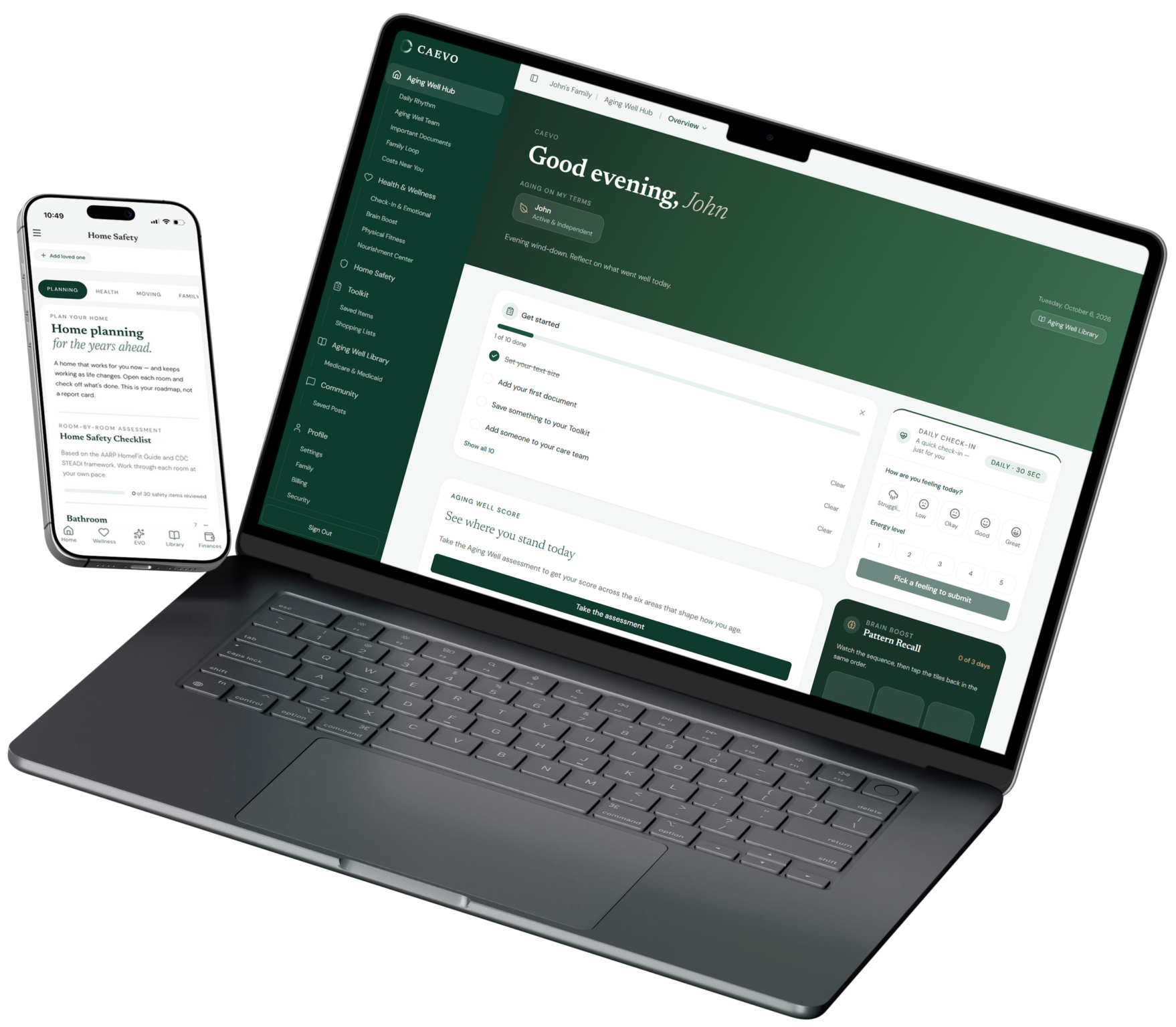
How CAEVO protects what matters most to your family
US hosting, encryption, row-level access, a consent gate, and a log of every crossing-privacy is built into how CAEVO works, from the start.
• Key Document Planning and Sharing • Easy Family Communication • Recommended Next Steps • Financial Resources • Aging Well Index • Document Vault • Benefits Finder • Care Stage Tracker • Family Loop • Consent-first Sharing • Ask EVO • 256-bit Encryption • No ads, ever
Every Crossing is Logged
United States Infrastructure
Encrypted in transit and at rest
Row level Access Control
Family Loop Consent Gate
The Family Record
Documents, Medication, Decisions
Our Promise on Trust
Families hand us the most sensitive things they own. Medication lists. Cognitive scores. Powers of attorney. A record of who decides when someone cannot. We take that seriously every day. Every record sits inside five layers. This is the order they’re in: US infrastructure, encryption in transit and at rest, row-level access control, the Family Loop consent gate, and every crossing logged, wrapped around the family record itself: documents, medications, decisions.
This page is the technical answer to the principles laid out in What We Believe. That page states what we hold to. This one explains how it’s actually built.
Your Data Stays on US Infrastructure
Member data stays on United States infrastructure, with a sub processor list we publish on request. For families, that’s a straightforward answer to a straightforward question. For partner organizations with their own compliance requirements, it’s the first thing your team will ask, and it’s confirmed in writing before you refer anyone.

Encrypted family records
There’s no plain-text copy of a family’s documents sitting anywhere in the system. Everything is encrypted in transit and in storage: medication lists, benefit records, shared documents, and the messages that pass between hubs—all of it, all the time.

Row-Level Access: Why "Family Account" Doesn't Mean "Family Access to Everything"
A permission that’s off isn’t merely hidden in the interface. It’s enforced at the database row. The record can’t be returned at all, so there’s nothing to query around, no back door, no admin view that happens to see more than the family intended.
This is the actual answer to “how is this different from sharing a login or a shared folder.” A shared folder shows everything to everyone with the password. Row-level access means the system itself can’t return what wasn’t granted, regardless of who’s asking.
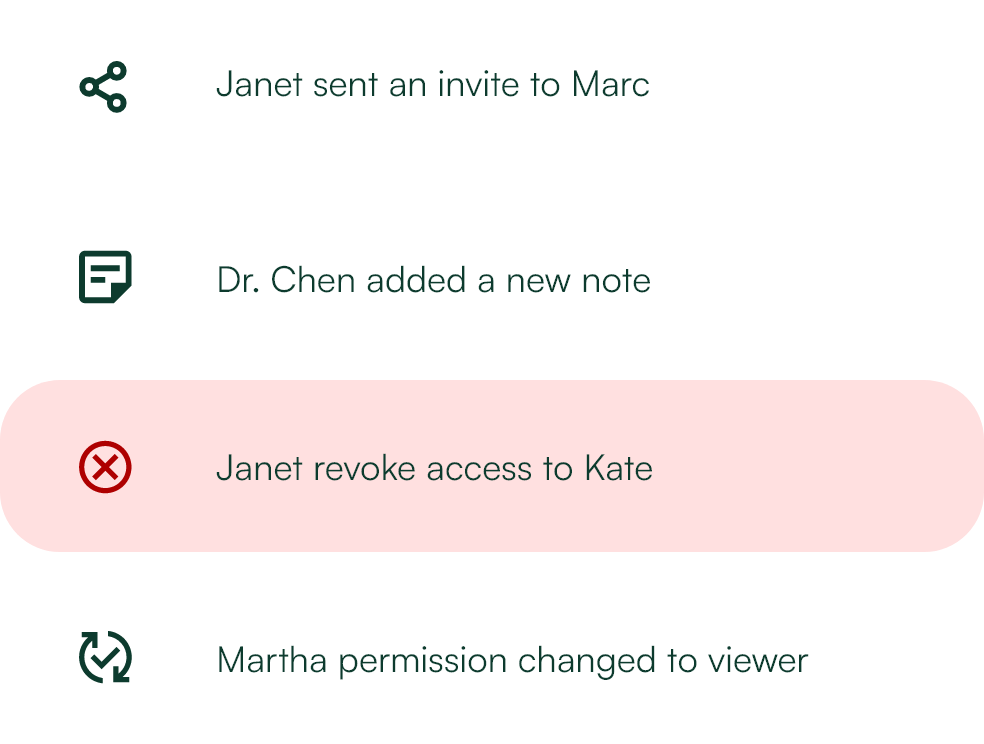
A Log of Every Crossing
Share, change, revoke: all of it writes to a log the family can read, including the access professionals have used. For the aging adult, that means never having to wonder what’s actually visible to someone else. For the family, it means never operating on an assumption about what they’re allowed to see.

The Consent Gate for Senior Data
Family Loop is closed by default. Nothing crosses from the Caregiver Hub to the Aging Well Hub until the person it belongs to grants it, one item at a time, and any grant can be withdrawn just as easily. There’s no state where consent is assumed, and no accumulation of access over time that nobody explicitly approved.
Built for the Moments This Actually Gets Used
Often at eleven at night, often by someone tired. We built for that.
Built for older eyes.
Larger type as the floor, not a setting someone has to find.
Reversible by default.
Anything you turn on, you can turn off in the same number of taps.
Plain language, always.
If a word needs a glossary, we find a better word.
Works on the phone they have.
Not the newest one. Tested on small screens and older devices.
No pressure.
No countdown timers and no manufactured urgency.
Quiet by default.
A tool for a hard season shouldn't add to the noise of it.
How We Keep Getting Better
Programs change, thresholds move, and states update their rules. The most useful thing a family can give us is the moment something didn’t work.
Something not working? Tell us what broke, what was missing, or what would have helped. It goes to a person.
A person reads it.
Not a queue nobody opens. Anything touching benefits gets checked against the source.
We fix the rule.
Not the single answer. If it was wrong for you, it was wrong for every family in your state.
We watch where people stop.
We watch where people stop. A drop-off tells us where to improve.
We remove what's unused.
Features nobody needs are clutter in front of someone who's exhausted.
Why This Matters, Whether You're a Family or a Partner
For families, these protections work whether or not you ever read this page. Every layer above exists whether or not you ever read this page.
For partner organizations, this is the answer to the questions your compliance team will ask before you refer anyone: where the data lives, how access is scoped, and what gets logged when a professional’s access is used.

Built from lived experience.
We watched people we love care for people they love, through cancer, dementia, and a fall that changed everything overnight. That is why CAEVO exists.
As we watched our own parents age, we saw something bigger than caregiving. They wanted to live their lives more fully, and their families wanted to support them through every chapter. Plan early, and it is a conversation around the kitchen table.
Lauren Howard & Jon Howard · Co-founders
What families are saying — on both sides of care
“A few months ago, there was a change in my father in law’s wife’s health. All the questions showed up. We started realizing how much of this process and what was to come was an unknown to us. It was scary and confusing to say the least. We heard about CAEVO and realized after a little investigation that it was the resource we needed. Memory loss and early dementia was in the future. CAEVO gave our family a guide and the resources we needed. Forever grateful for this resource and the team who made it happen. “
Kieth P., CAEVO User
“Great product and a huge stress relief. My parents are both approaching 80 and I’m fairly unorganized as it is. CAEVO has helped keep tabs and important info on my parents at my fingertips without stressing or sacrificing time with my kids.”
Nick F., CAEVO User
“I’m also a user, and here’s my honest take.
I used CAEVO to help plan care for my dad. My sister and I are his co-conservators, and keeping track of everything was a mess.
If you’re caring for a parent or planning for your own later years, it’s worth downloading.”
John G., CAEVO User
Frequently Asked Questions
Is CAEVO for caregivers or for people planning their own aging?
Both. Every account has both hubs, and you can add and switch between more than one family, like a spouse’s parents and your own.
Is CAEVO free?
To start, yes. Essentials is free, always, for one person. It includes both libraries and the everyday tools on each side, with no credit card required.
Is my family's information safe?
Yes. It’s encrypted with bank-level, 256-bit security and stored on US infrastructure, and the person aging controls what’s shared. See how we protect your data
Will I see everything about my parent?
No, you see what they choose to share. That’s on purpose. It keeps CAEVO from feeling like it’s watching anyone.
Can CAEVO find benefits I qualify for?
It shows you the programs in your state and county, like waivers, transportation, meals, respite, and legal aid, across all 50 states and DC.
My advisor, attorney, home care agency, or community offered me CAEVO. Do I pay?
If your organization covers it, you don’t need a paid plan. Check with them, or contact us to confirm before you sign up for anything.
Stay Informed

The Conversation Nobody Wants to Have With Their Parents (and How to Start It)
Most families wait for a crisis to talk about aging. Here’s how to open the conversation before you’re forced to — and what to actually ask.

Sandwich Generation, Meet Your New To-Do List
Managing your kids’ schedules and your parents’ care at the same time isn’t a time-management problem — it’s a coordination problem. Here’s what that actually looks like.

The Conversation Nobody Wants to Have With Their Parents (and How to Start It)
Most families wait for a crisis to talk about aging. Here’s how to open the conversation before you’re forced to — and what to actually ask.

The Conversation Nobody Wants to Have With Their Parents (and How to Start It)
Most families wait for a crisis to talk about aging. Here’s how to open the conversation before you’re forced to — and what to actually ask.
A family that talks about aging early has more time to enjoy it.
CAEVO gives you the tools to start that conversation this week.
Available on